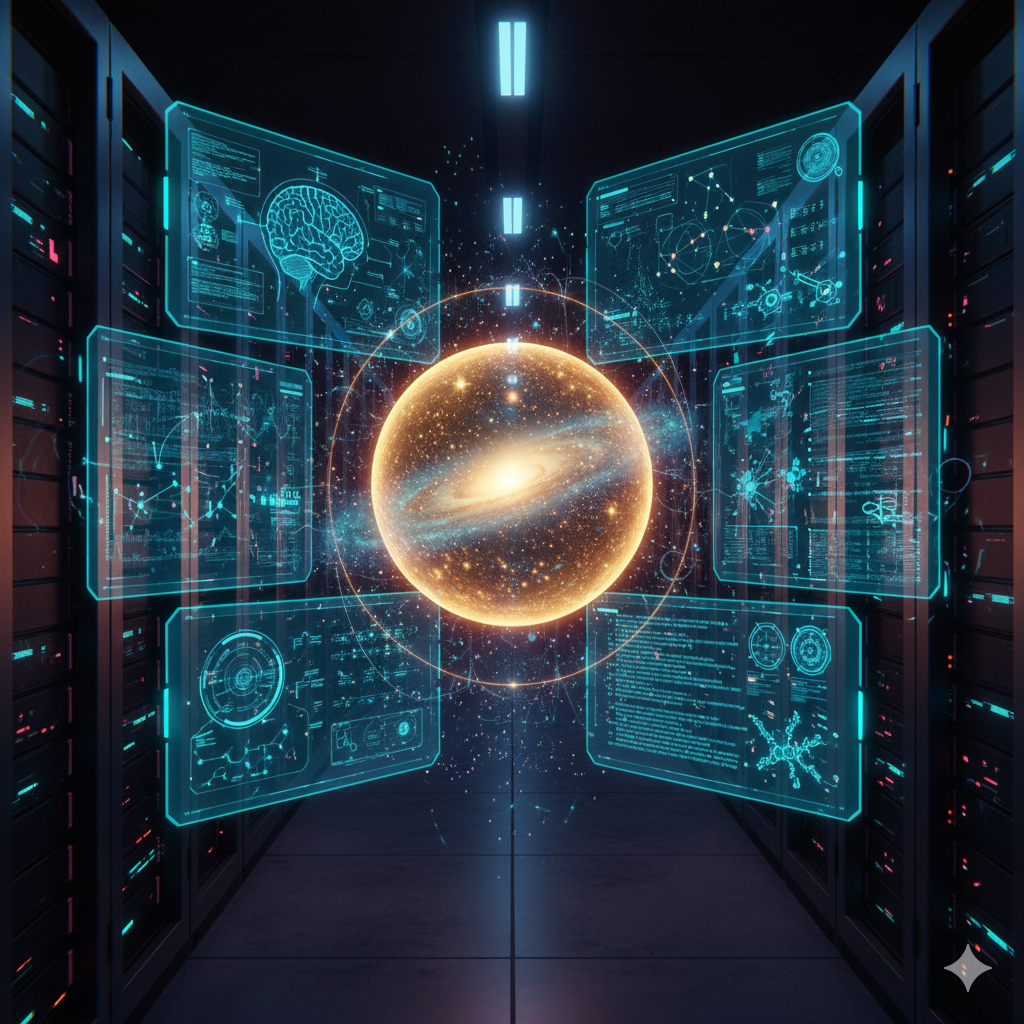
What If God Actually Exists?
An Exploration of Divine Existence Through Science
What If God Actually Exists?
Across all religions and cultures, humanity has pondered the concept of a higher power—a God who is immortal, omnipotent, and omnipresent. Ancient scriptures describe heavens and hells, realms of unimaginable bliss or suffering, with deities capable of traveling faster than light, wielding infinite energy, and performing feats that defy our understanding of reality. While these ideas often seem mystical, what if they could be explained, or at least envisioned, through the lens of modern science?
Could the characteristics of God—immortality, omniscience, and boundless power—find a place within the realms of quantum theoretical physics or string theory? Science has already begun to uncover phenomena that once seemed purely fantastical. The notion of faster-than-light travel, for example, parallels the concept of quantum entanglement, where particles separated by vast distances instantaneously influence each other. Similarly, the infinite energy described in scriptures may correlate with the zero-point energy field, a concept suggesting an ever-present, limitless energy within the fabric of spacetime.
String theory offers another profound avenue for exploration. By proposing that the universe is composed of vibrating strings at its most fundamental level, it opens the door to the possibility of extra dimensions beyond the familiar three spatial dimensions and one temporal dimension. What if heaven and hell exist in these higher dimensions, inaccessible to us but deeply intertwined with the universe we perceive? Could a Type VII civilization—entities far beyond human comprehension—master these dimensions, achieving what we might perceive as divine attributes?
In this exploration, we venture into the fascinating intersection of science, religion, and philosophy to ask: If God exists, could science provide insights into this profound possibility? By examining advanced civilizations, the Kardashev scale, quantum consciousness, and the mysteries of universal constants, we will unravel how the divine might manifest in a scientifically grounded universe.
The Concept of God: Bridging Science and Philosophy
The concept of God has been a cornerstone of human thought across cultures, religions, and mythologies. While interpretations vary, the idea of a supreme being or force has consistently served as an answer to existential questions and a source of moral guidance. From ancient civilizations to modern pop culture, the portrayal of God intertwines the mystical and the tangible, often leaving us to wonder: could there be a unifying explanation for these diverse representations, one that aligns with modern science?
In Hinduism, the notion of God is multifaceted, ranging from the formless ultimate reality, Brahman, to the anthropomorphic deities like Vishnu and Shiva. Hindu philosophy delves into cosmic cycles, parallel realities, and the idea of time as cyclical, concepts that intriguingly align with modern scientific theories like multiverses and time dilation. For example, Lord Vishnu’s ability to appear simultaneously in different places resonates with quantum superposition, where particles exist in multiple states at once.
Christianity speaks of an omnipotent, omniscient, and omnipresent God who created the universe ex nihilo (out of nothing). Miracles such as walking on water, resurrection, and omnipresence are central to the faith. These can be metaphorically linked to quantum physics phenomena, such as particles appearing and disappearing in the quantum vacuum, or entanglement, which might hint at how information can transcend space-time barriers.
In Islam, Allah is described as the ultimate creator and sustainer of the universe, with attributes of mercy, justice, and omnipresence. The Quran emphasizes the balance and order of creation, reflecting the fine-tuning of universal constants that modern cosmologists continue to study. Could this balance be indicative of a conscious design, a higher intelligence that fine-tuned the cosmos to support life?
Ancient Roman and Greek mythology portrayed gods as beings with human-like emotions but possessing superhuman powers—Zeus commanding lightning or Poseidon ruling the seas. These deities were deeply intertwined with nature, embodying its forces. While they were not omnipotent in the monotheistic sense, their powers resemble advanced technology or mastery over nature, which could align with the capabilities of a Type VII civilization. Could these myths be allegories for ancient encounters with advanced intelligences or representations of humanity's aspirations to transcend its limitations?
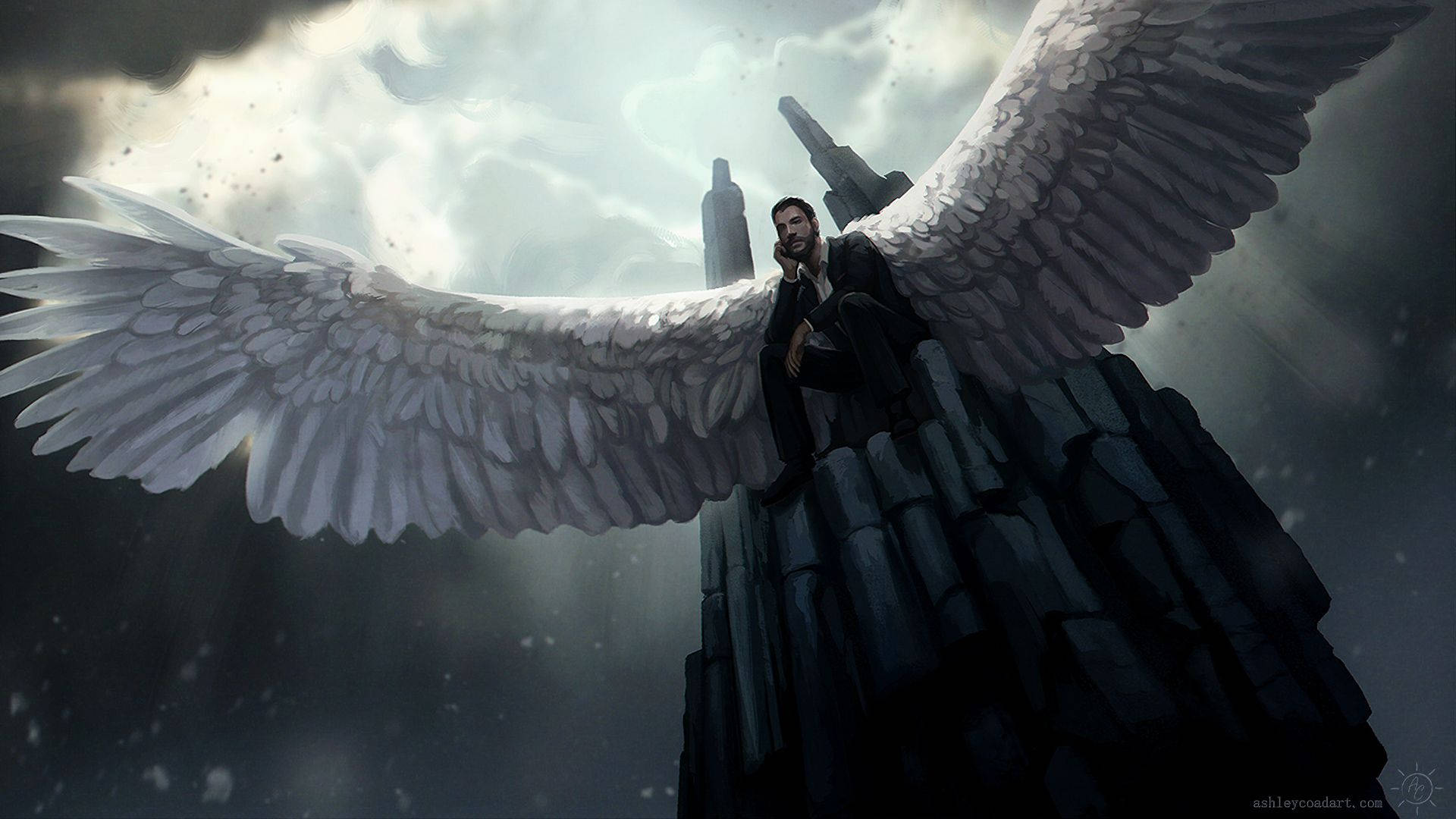
Modern media has also reimagined divinity in fascinating ways. The TV show Lucifer humanizes the Devil, portraying him as a complex being navigating moral dilemmas. Such stories challenge traditional views, suggesting that even divine or semi-divine beings might grapple with the same questions of purpose and morality as humans. These interpretations resonate with philosophical debates about the nature of free will, consciousness, and the ultimate source of good and evil.
By examining these diverse representations, one sees a common thread: the longing to understand forces greater than ourselves. Whether through ancient scriptures, mythological tales, or modern storytelling, humanity has consistently imagined beings with powers that challenge the boundaries of science and reality. Perhaps, these narratives are not merely imaginative but echo deeper truths about the nature of existence—truths that science is only beginning to uncover.
Advanced Civilizations: The Type VII Hypothesis
The Kardashev Scale, proposed by astrophysicist Nikolai Kardashev in 1964, is a framework for classifying civilizations based on their ability to harness and utilize energy. The scale begins with Type I civilizations, which can harness all the energy available on their planet, and progresses to Type II, which control the energy of an entire star, and Type III, which command the resources of their entire galaxy. But what lies beyond Type III?

Many scientists and futurists speculate about civilizations far beyond our comprehension, culminating in the hypothetical Type VII civilization. Such a civilization would not only control energy at the universal scale but could manipulate the very fabric of reality—space, time, and dimensions. It’s this level of mastery that might align with our understanding of a "God-like" entity, transcending the physical and entering realms described by quantum mechanics and string theory.
A Type VII civilization would likely possess complete knowledge of quantum consciousness, potentially understanding the universe as a vast, interconnected web of information. This civilization could operate within higher-dimensional spaces, beyond the four dimensions we experience. These dimensions, as postulated by string theory, could explain phenomena like omnipresence and omniscience. If higher dimensions house the true structure of reality, such beings would navigate them effortlessly, appearing "divine" to lower-dimensional observers like us.
Energy, often depicted as infinite and boundless in religious texts, would be under the full control of a Type VII civilization. This mastery could extend to harnessing the energy of black holes, manipulating zero-point energy fields, or even controlling the expansion of the universe itself. In this sense, the miracles described in many religious texts—such as creating life, resurrecting the dead, or shaping matter at will—could be scientific feats achievable by such an advanced civilization.
One of the most fascinating aspects of a Type VII civilization is its potential mastery over time. For such entities, time could be as malleable as space, enabling them to travel through it, observe it, or even reshape it entirely. This idea resonates with the timelessness often attributed to divine beings in religious traditions. For instance, the idea of God being eternal and unchanging aligns with the scientific notion of a being existing outside the constraints of time and entropy.
The Type VII hypothesis challenges us to rethink our definitions of divinity and intelligence. If such civilizations exist, their abilities could account for many of the supernatural phenomena described in religious and mythological texts. Perhaps these accounts are echoes of interactions with beings that have achieved such advanced states. Alternatively, they could be the aspirations of humanity, glimpsing what we might one day become.
While the existence of a Type VII civilization remains speculative, the pursuit of this idea pushes the boundaries of science, philosophy, and imagination. It invites us to consider the possibilities of our own evolution and the nature of ultimate knowledge and power. In doing so, it bridges the gap between the scientific quest for understanding and the age-old yearning for a connection to something greater than ourselves.
Quantum Consciousness: A Scientific Perspective on Omnipotence
One of the most profound questions in science and philosophy is the nature of consciousness. What is it, where does it come from, and how might it relate to the universe itself? Some scientists and thinkers propose that consciousness might not be a mere byproduct of the brain but a fundamental aspect of reality—a quantum phenomenon interwoven with the fabric of existence. This idea, known as quantum consciousness, provides a fascinating perspective on the concept of omnipotence attributed to divine beings.
In religious texts, God is often described as all-knowing, present everywhere, and capable of orchestrating events on an infinite scale. In quantum mechanics, the universe operates on a probabilistic framework, where particles exist in superposition—being in multiple states simultaneously—until observed or measured. Could a consciousness with the ability to influence these quantum states on a universal scale be what we perceive as omnipotence?
Theories like the Orch-OR (Orchestrated Objective Reduction) model, proposed by physicist Sir Roger Penrose and anesthesiologist Stuart Hameroff, suggest that consciousness arises from quantum processes within the brain. If this is true for humans, could a universal consciousness exist, one that governs the quantum realm itself? Such an entity could, in theory, manipulate particles, probabilities, and events across the cosmos, embodying the omnipotence described in religious and mythological narratives.
The idea of quantum consciousness aligns intriguingly with the notion of interconnectedness present in many spiritual traditions. For instance, Hinduism speaks of Brahman, the ultimate reality, as the essence that permeates everything. Similarly, Buddhism describes the concept of oneness and interdependence. In a quantum sense, this could mirror the phenomenon of entanglement, where particles remain connected regardless of distance, instantaneously affecting one another. A being with mastery over such entanglement could theoretically manipulate the entire universe at will, achieving a level of control indistinguishable from divinity.
Beyond the brain, some scientists hypothesize that the universe itself might be conscious—a concept known as panpsychism. If every particle or quantum system contributes to a universal consciousness, then the universe might "think," "feel," or "know" in ways we cannot yet comprehend. This universal mind could be the scientific basis for the divine omniscience described in Christianity, Islam, and other faiths, where God is aware of all events and intentions.
Furthermore, the ability to influence quantum probabilities could explain the seemingly miraculous events described in religious texts. For example, the parting of the Red Sea in the Bible, or Krishna lifting Mount Govardhan in Hindu mythology, might reflect quantum manipulation on a macroscopic scale. Such feats, while impossible for human beings bound by classical physics, might be trivial for a consciousness operating at the quantum level.
The exploration of quantum consciousness opens the door to a new way of understanding omnipotence, one grounded in the mechanics of the universe itself. If a being or entity exists that can harness and direct the quantum fabric of reality, it would possess power so immense that it would appear godlike to us. As our understanding of quantum mechanics deepens, we inch closer to uncovering whether such a universal consciousness is merely speculation or an inherent feature of our reality.
N-Dimensionality and the Foundations of Creation
The idea of higher dimensions has fascinated humanity for centuries, often finding expression in religious, philosophical, and scientific thought. From the heavens described in sacred texts to modern theories in physics, higher dimensions have been proposed as realms beyond ordinary human perception. Could these higher dimensions hold the key to understanding the foundations of creation, and perhaps even the spiritual concepts of heaven and hell?
In string theory, a prominent framework in theoretical physics, the universe is thought to consist of more than the familiar three spatial dimensions and one temporal dimension. It proposes up to 11 dimensions, some of which are "compactified," meaning they are curled up so tightly that they are imperceptible to us. These extra dimensions could be home to phenomena that appear otherworldly from our perspective, potentially explaining the existence of realms that religious traditions describe as heaven and hell.
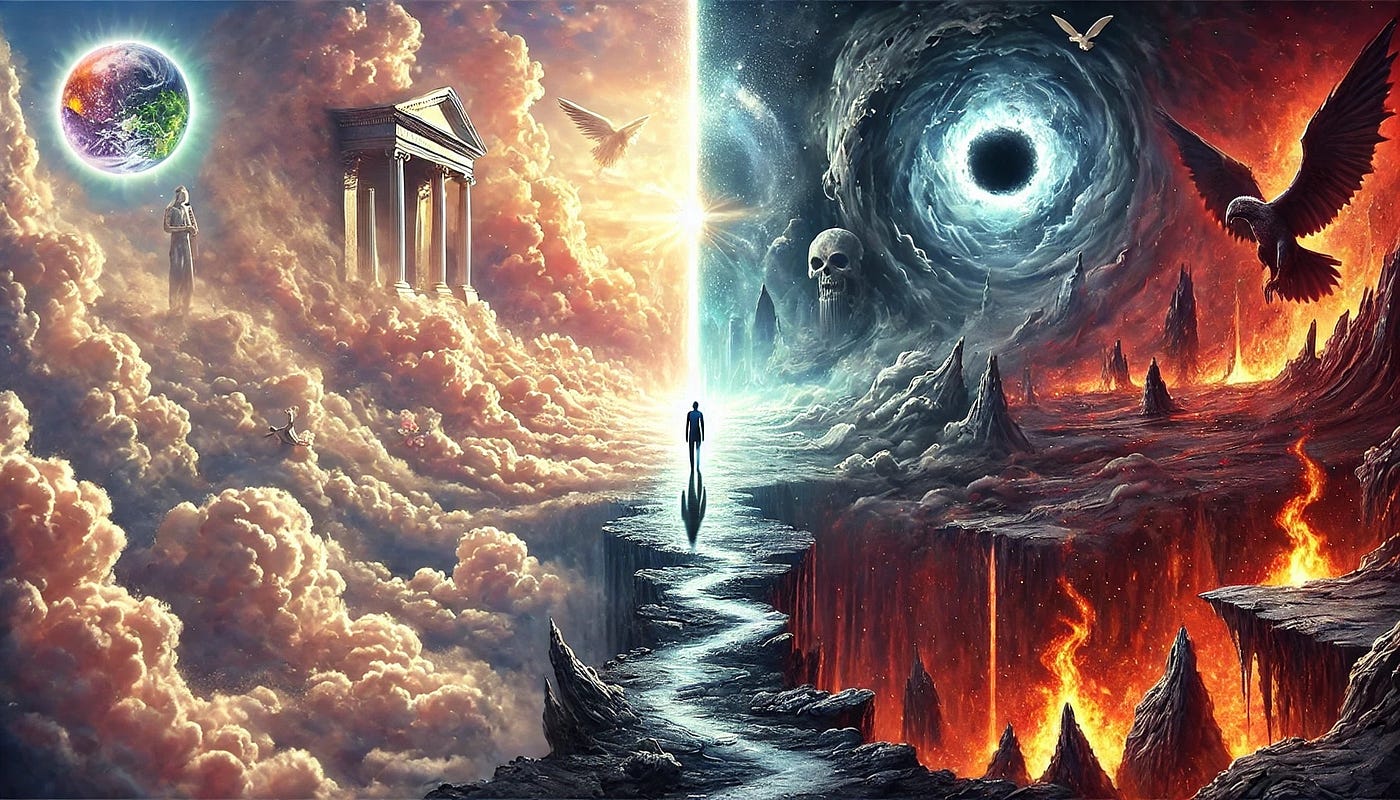
In many cultures, heaven is depicted as a place of bliss, peace, and divine presence, while hell is a realm of suffering, punishment, and separation from divinity. These descriptions often parallel the dichotomy of higher and lower vibrational states in physics and metaphysics. If higher dimensions are associated with higher energy states, they could be perceived as realms of enlightenment or ultimate harmony—much like the heavens in religious texts. Conversely, lower dimensions or chaotic states might resemble the torment and disorder associated with hell.
Hinduism, for instance, speaks of numerous lokas (worlds or realms), each existing at different planes of existence. Svarga (heaven) is described as a place of celestial beauty, while Naraka (hell) is depicted as a realm of punishment and purification. Christianity and Islam similarly describe paradises of eternal reward and infernal pits of punishment, often located beyond our earthly plane. These spiritual narratives may metaphorically align with the scientific notion of different dimensional layers, with access to higher dimensions requiring a transcendence of physical limitations.
N-dimensionality also raises fascinating possibilities for the mechanics of creation itself. A being capable of perceiving and interacting with all dimensions simultaneously would appear to us as omnipotent and omnipresent, possessing a level of mastery over reality that aligns with descriptions of God. In this context, the act of creation could be envisioned as the manipulation of higher-dimensional structures to give rise to the lower-dimensional world we inhabit. For instance, just as a 3D being can easily manipulate a 2D plane, a higher-dimensional entity could shape the physical universe as effortlessly as molding clay.
Could heaven and hell, then, be higher and lower-dimensional realities, where consciousness experiences different states of existence based on its vibrational or energetic alignment? Quantum physics offers some intriguing support for this notion. Quantum tunneling, entanglement, and the idea of parallel universes suggest that multiple realms or dimensions might coexist with our own, separated only by barriers we cannot yet traverse. For beings who have transcended such barriers, moving between these realms might be as simple as stepping through a door.
From a scientific standpoint, these ideas offer a profound reinterpretation of ancient spiritual teachings. Heaven and hell may not be distant, metaphysical places but rather dimensions intertwined with our own reality. Their existence could depend on states of consciousness and energy that we are only beginning to understand. Exploring these possibilities bridges the gap between age-old religious doctrines and cutting-edge physics, offering a glimpse into the astonishing complexity and interconnectedness of creation itself.
Energy Beyond the Universe: Mastery Over Universal Laws
Energy is the driving force behind all phenomena in the universe. From the movement of galaxies to the chemical reactions that sustain life, energy governs the behavior of matter and defines the boundaries of what is possible. But what if there were entities capable of not just harnessing energy within the universe but also accessing and controlling energy beyond it? Such mastery would represent a level of power that transcends known physical laws, bringing us closer to understanding the divine attributes often associated with God.
In religious and mythological narratives, gods are often described as wielding infinite energy to create, destroy, and reshape reality at will. This divine energy could correspond to the scientific concept of "zero-point energy," the inherent energy present even in the vacuum of space. According to quantum field theory, the vacuum is not truly empty but teeming with fluctuating energy fields. If a civilization or entity could tap into this limitless reservoir, it would achieve a level of power that seems indistinguishable from the omnipotence described in religious texts.
Beyond zero-point energy, advanced physics also explores concepts like dark energy and dark matter, which constitute the majority of the universe's mass-energy content. Dark energy is thought to drive the universe's accelerated expansion, while dark matter influences the gravitational structure of galaxies. A being with the ability to manipulate these mysterious forces could control the very shape and fate of the cosmos, bending space-time to its will and creating entirely new realms of existence.
Theoretical physicists have also speculated about the possibility of energy existing in higher dimensions. String theory, for example, posits the existence of "branes," multidimensional surfaces where energy and matter might interact in ways beyond our comprehension. If a civilization—or an entity—could access these higher-dimensional energy sources, it could rewrite the fundamental laws of our universe. This aligns with religious notions of creation, where divine beings are said to command energies that surpass human understanding.
Interestingly, this mastery over universal and extra-universal energy mirrors descriptions of miracles found in ancient texts. For instance, the Hindu god Vishnu is said to sustain the cosmos with his infinite energy, while the Bible describes God creating the universe with a single command: "Let there be light." These acts, though framed in spiritual terms, might reflect an advanced understanding of energy manipulation, allowing for instantaneous creation or transformation.
The potential to control energy at this level would also grant dominion over entropy, the measure of disorder in a system. In our universe, entropy always increases, leading to the eventual "heat death" of the cosmos. A being capable of reversing entropy or sustaining perpetual energy flow would effectively conquer the ultimate law of thermodynamics, achieving a state of immortality for itself and its creations. Such a feat aligns with the eternal nature attributed to God in many traditions.
Energy beyond the universe isn't just a theoretical concept—it is a profound bridge between science and spirituality. By exploring these possibilities, we not only expand the boundaries of physics but also bring new light to ancient ideas of divinity, creation, and omnipotence. Perhaps the ultimate truth lies in the synergy of these perspectives, offering a glimpse into the infinite potential of existence itself.
Evidence in the Universe: Hints of Higher Intelligence?
The universe is a tapestry of mystery, beauty, and complexity. From the formation of galaxies to the emergence of life, every phenomenon prompts profound questions. Could these be the fingerprints of a higher intelligence? Why did inanimate matter evolve into conscious beings capable of pondering the cosmos? Are there clues in the universe that suggest the presence of advanced civilizations or even a divine architect?
One of the great mysteries of science is the origin of life itself. Chemistry alone cannot fully explain the leap from a primordial soup of molecules to the first self-replicating organisms. Known as abiogenesis, this transition remains elusive despite decades of study. The question arises: was this leap purely a matter of chance, or was it guided by an unseen hand? The incredible complexity of even the simplest life forms, such as bacteria, suggests a precision that some argue hints at intelligent design. Could this design be the work of an advanced civilization, or even a universal consciousness shaping the building blocks of existence?
Another enigma lies in the fine-tuning of the universe. The fundamental constants of physics—such as the gravitational constant, the charge of the electron, and the cosmological constant—are astonishingly precise. Even slight deviations in these values would render the universe inhospitable to life. This phenomenon is often referred to as the "anthropic principle," and it raises the question: is this precision the result of sheer luck, or does it reflect the work of an intelligent force setting the stage for life to emerge?
The Fermi Paradox adds another layer to this puzzle. If the universe is so vast and teeming with billions of stars and planets, why haven’t we encountered evidence of extraterrestrial intelligence? Some theories suggest that advanced civilizations may deliberately hide their presence or operate at a level far beyond our ability to detect. Known as the "Zoo Hypothesis," one idea posits that Earth is observed like a cosmic nature reserve, with higher beings choosing not to interfere with our development. Could these civilizations be waiting for humanity to reach a certain level of maturity or understanding before revealing themselves?
Another possibility is that advanced intelligences are responsible for some of the unanswered questions in our understanding of reality. For instance, dark matter and dark energy constitute approximately 95% of the universe, yet their nature remains unknown. Could these mysterious substances be manifestations of advanced technologies or constructs designed by higher beings? Similarly, phenomena like black holes, which warp space and time, might be natural phenomena—or could they serve as gateways or energy sources for civilizations far beyond our comprehension?
Historical and modern accounts of unexplained phenomena also add intrigue. Ancient texts from various cultures describe interactions with divine beings, celestial chariots, or mysterious lights in the sky. While these could be symbolic or mythological, could some represent early encounters with advanced civilizations? Even in modern times, reports of unidentified aerial phenomena (UAPs) challenge our understanding of physics and technology. Are these glimpses of higher intelligence, observing or guiding humanity from the shadows?
The question of why we have not yet answered these mysteries also ties into our limitations as a species. It is possible that our current understanding of science is akin to a child trying to grasp the complexities of calculus. Advanced civilizations, if they exist, might operate on principles so advanced that they seem indistinguishable from magic. The limits of human perception, technology, and understanding might be the very barriers that prevent us from finding the answers we seek.
Whether through the intricate design of life, the fine-tuned constants of the universe, or the eerie silence of the cosmos, hints of higher intelligence abound. While we cannot yet say whether these point to advanced civilizations, divine forces, or something entirely beyond our imagination, they compel us to keep searching. Each mystery is an invitation to expand our knowledge and understanding, bridging the gap between science, philosophy, and the possibility of something greater.

Implications for Humanity and Our Quest for Meaning
The possibility of higher intelligences, divine forces, or advanced civilizations reshapes how we view ourselves and our place in the cosmos. It challenges us to confront profound questions: What is humanity's role in a universe that might harbor beings far beyond our comprehension? How do these possibilities influence our understanding of meaning, morality, and the trajectory of our existence?
If advanced civilizations or a divine intelligence exist, humanity’s place in the cosmic hierarchy becomes both humbling and inspiring. It suggests that we are part of a grander design, an evolving story of consciousness and discovery. The realization that we are not alone—whether in the spiritual sense or the physical—could dissolve the barriers that divide us, fostering a deeper sense of unity as a species. After all, in the face of entities capable of bending the laws of the universe, the petty conflicts of humanity pale in significance.
At the same time, such possibilities challenge us to rethink our understanding of morality and purpose. Many religious traditions teach that human lives are guided by divine plans, with moral codes derived from higher powers. If these higher intelligences or entities are real, their existence could validate such beliefs. However, it also raises ethical questions: What responsibilities do we have as beings capable of contemplating our creators? How should we act if we discover we are being observed or guided by more advanced entities?
From a scientific perspective, the potential existence of higher intelligences encourages us to push the boundaries of discovery. Whether through exploring quantum consciousness, probing higher dimensions, or seeking extraterrestrial life, the quest for knowledge becomes a shared endeavor that unites science, philosophy, and spirituality. Every breakthrough brings us closer to understanding not just the universe, but also ourselves and the forces that might have shaped us.
For many, the search for higher intelligence is deeply tied to the quest for meaning. What drives humanity to explore the stars or unravel the mysteries of the quantum realm is the same force that compels us to ask why we exist. If we one day confirm the existence of advanced civilizations or divine entities, it might answer some questions but raise many others. What do these beings want? What is the ultimate purpose of creation? And how do we fit into their vision of the cosmos?
Perhaps the most profound implication is that our quest for higher intelligence reflects the nature of humanity itself. Whether or not we ever encounter a higher power, the act of searching brings out the best in us—our curiosity, creativity, and capacity for awe. It is through this search that we build meaning in our lives, transcending the mundane to connect with something greater.
Ultimately, the possibility of higher intelligences or divine forces serves as both a challenge and an inspiration. It urges us to expand our horizons, seek understanding, and strive for progress while remaining grounded in the values that make us human. Whether through science, philosophy, or spirituality, the quest for meaning is a journey that unites us all, reminding us that the mysteries of the universe are as much about the questions we ask as the answers we find.
The Intersection of Science, Religion, and Philosophy
Science, religion, and philosophy have long been viewed as separate realms, each addressing different aspects of existence. Science seeks to explain the mechanics of the universe, religion explores the divine and spiritual, and philosophy grapples with meaning, ethics, and existence itself. Yet, as humanity delves deeper into the mysteries of reality, the boundaries between these disciplines begin to blur, revealing a profound interconnectedness that enriches our understanding of the cosmos and our place within it.
Science, with its rigorous methodology, has provided remarkable insights into the physical universe. The Big Bang theory, quantum mechanics, and string theory offer explanations for the origins and workings of existence. Yet, as science uncovers deeper truths, it encounters questions that verge on the metaphysical. For instance, why does the universe exist at all? What is the source of the laws of physics? These questions invite the perspectives of religion and philosophy, which have long grappled with the idea of a prime mover or ultimate cause.
Religion, in turn, provides rich narratives about creation, purpose, and the nature of the divine. From the Judeo-Christian belief in a God who created the universe ex nihilo to the Hindu notion of Brahman as the ultimate reality, religious traditions offer frameworks that resonate with scientific concepts like the multiverse or the fine-tuning of universal constants. Rather than being at odds, these traditions can complement scientific inquiry, offering symbolic or philosophical interpretations that inspire new ways of thinking.
Philosophy acts as a bridge between science and religion, asking questions that neither can fully answer alone. It examines the ethical implications of scientific discoveries, explores the logical coherence of religious claims, and probes the very nature of knowledge and existence. Philosophical ideas such as dualism, materialism, and panpsychism offer perspectives on the mind-body problem and the nature of consciousness—issues that resonate with both scientific theories like quantum consciousness and religious beliefs about the soul.
A striking example of this intersection is the idea of creation itself. Science describes the Big Bang as the beginning of the universe, yet it cannot explain what preceded it or why it occurred. Religion speaks of a divine creator, offering purpose and intentionality to existence. Philosophy, meanwhile, asks whether the universe requires a cause at all or if existence is an intrinsic property of reality. Together, these perspectives form a tapestry of understanding that no single discipline can achieve alone.
The convergence of these fields also extends to ethics and meaning. For example, advancements in artificial intelligence and genetic engineering raise questions about what it means to be human and what limits we should place on our pursuit of knowledge. Religious teachings often provide moral guidance, while philosophy helps us navigate the complexities of modern dilemmas. Science, for its part, offers the tools to understand the consequences of our choices, making this intersection essential for addressing humanity's greatest challenges.
Perhaps the most profound realization from this intersection is that humanity’s search for truth is universal. Whether through a telescope, scripture, or thought experiment, we are all striving to understand the same mysteries. The interplay of science, religion, and philosophy is not a competition but a collaboration, with each discipline enriching and challenging the others. Together, they offer a holistic approach to the timeless questions of where we come from, why we exist, and what lies beyond.
Conclusion: The Boundaries of Knowledge
Humanity’s quest to understand the universe is as ancient as our existence itself. From gazing at the stars to probing the depths of quantum mechanics, we have sought to uncover the truths that define reality. Yet, despite our progress, many mysteries remain. What lies beyond the observable universe? What is the nature of consciousness? Is there a higher intelligence guiding existence? These questions remind us that the boundaries of knowledge are not static but ever-expanding, inviting us to explore further.
The concept of God, advanced civilizations, or universal consciousness might seem speculative, but they serve as powerful frameworks for pondering the unknown. They bridge the gaps between science, religion, and philosophy, offering perspectives that are both humbling and inspiring. Whether such entities exist as realities or metaphors, they compel us to think deeply about our place in the cosmos and the potential of what lies ahead.
The boundaries of knowledge are not limitations but opportunities. Each question we ask and each mystery we solve reveals a deeper layer of complexity, challenging us to evolve our understanding. It is this unending curiosity that defines humanity, propelling us forward as explorers of the infinite. In our pursuit of knowledge, we not only seek answers but also create meaning, finding purpose in the very act of exploration.
Whether we one day confirm the existence of God, higher civilizations, or multidimensional realities, the journey itself is transformative. It connects us to the universe and to each other, reminding us that we are part of something far greater than ourselves. The boundaries of knowledge are not barriers to be feared but frontiers to be embraced, guiding us toward a future where the mysteries of existence might finally be revealed.
In the end, the search for understanding is a reflection of humanity’s greatest strengths: our creativity, resilience, and capacity for wonder. As we stand at the edge of what we know, gazing into the vast unknown, we are reminded that it is not the answers but the questions that define us. And in those questions lies the promise of discovery, the possibility of connection, and the hope of uncovering the ultimate truths of existence.
Written by Aryan Singh.